
1931 press reports
Church Times, 23 October 1931; East Anglian Daily Times, 16 October 1931; and
others
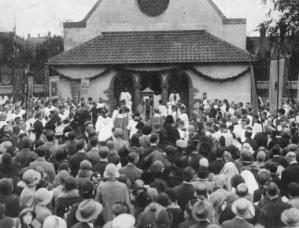
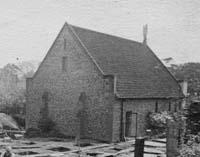
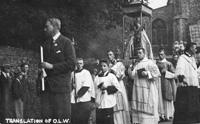
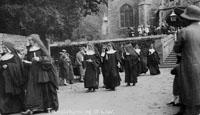
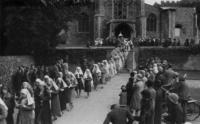
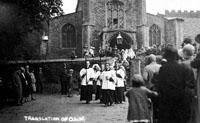
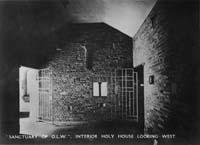
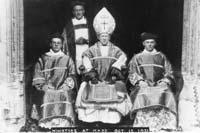
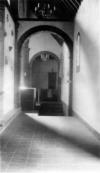
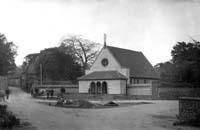
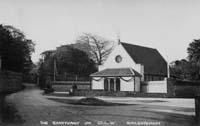
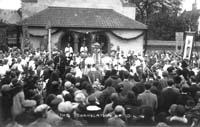
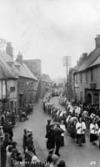
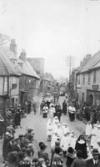
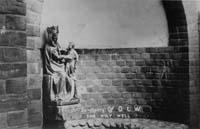
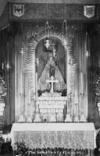
The photographs on this page were not in the newspapers* : they are the Shrine's official
photographs of the day (issued in postcard form), and various other pictures surrounding
the Translation, taken by Fr Patten and pilgrims before and after the day.
*except for the official photograph of the procession
about to enter the new Shrine [shown right] which was
used in the newspapers and elsewhere
if you are not familiar with the earlier layout of the
village, Enid Chadwick's 1935 map may help
from the Church Times 23 October 1931
“ENGLAND’S NAZARETH”
Opening of Our Lady’s Shrine at Walsingham
(By a Special Correspondent)
Walsingham, in Norfolk, is a quiet village. The grey flint houses, the long, high wall that encloses the
ruins of the Priory of the Augustinian Canons, the Common Place, or square, round which stand the old
hostelries for pilgrims visiting the shrine of Our Lady, wear the appearance of a long indifference to the
passing of time and to the changing of generations. Walsingham has known years of fame and of
prosperity, of disrepute and of ruin, and, finally, a time of long neglect.
But, on Thursday of last week, the village street, that winds up from the church, skirting the Priory
lands, was prepared for a sight such as has not been seen in Walsingham – nor, I imagine, in any
other English village – for centuries. The shrine of our Lady, a copy of the ancient shrine set up before
the Norman Conquest and destroyed in Reformation days, was to be carried in solemn procession from
the parish church to a new sanctuary. As in old days the shrine had stood in a chapel of its own, so
now again a house has been built for it; modelled in the form of the House of Nazareth, where our
Lady received the news of the coming of the Saviour of mankind. From ancient times the house and
the shrine were given the name of “England’s Nazareth”.
The customary greyness of the village street was transformed. The three hundred people who had
come to Walsingham by special train from London, found their way to the church under arches of
many-coloured garlands. In the lattices of the cottages hung posies of flowers, and flags and
streamers spanned the streets from window to window of the houses and village shops.
Walsingham church, like many of the beautiful fourteenth-century village churches, will hold as many
as six hundred people. But when I entered it for the High Mass, which
was to precede the translation of the shrine. I found that it was already
nearly full, and still there were numbers of
visitors, travellers and pilgrims coming
from the station. Every seat in the Lady-
chapel was taken. The front of the nave
was reserved for the eighty priests who
had come from parishes far and near.
Members of guilds and confraternities filled
the remaining seats, and crowds were left
standing in the side aisle, in the space round the font, and in the porch at
the west end.
In honour of the mystery of the Holy Incarnation, the Mass of our Lady was sung by Bishop O’Rorke,
pontificating from the fald-stool. He made his way through the press of the people at the back of the
church, and entered the sanctuary, where deacon, sub-deacon and assistant priest awaited him.
There, before the altar, he was vested in the full Mass vestments of a Bishop for great occasions – alb,
tunicle, dalmatic, chasuble and mitre.
“The Word was made Flesh”. The great truth of the Incarnation of the Son of God, confessed by every
member of the congregation in the Eucharistic Creed, was the subject of words spoken by the Rev
Ernest Underhill, late vicar of St Thomas, Toxteth, Liverpool, at sermon time. Mr Underhill looked back
over seventy or eighty years of the history of the revival of Catholicism in England. At first, he said,
some thought that the Catholics of the Movement were lacking in the presentation of the whole
faith. But it was in God’s good mercy that progress went slowly. Our fathers did not hesitate to
teach the Faith concerning the Blessed Sacrament, nor to remind us that we were a sin-laden
people, for whom the Church gave her cleansing Sacrament of Penance. But in the early days of
the revival, it is true to say that Mary was hardly known. In God’s good time our Blessed Lady
began to hold again her rightful place in men’s esteem. The translation of our Lady’s shrine to the
new chapel now was, he said, more than a parish matter: it was something that affected all
England. To honour our Lady was to bear witness to that which her meek acceptance of the
angel’s message had made possible, the coming of God on earth in
human flesh. The sanctuary prepared for her shrine at Walsingham
was a reminder to all who entered it of the Home at Nazareth, where
Mary nursed the Babe, who was God Almighty.
After Mass, luncheon was given to the pilgrims at the “Hospice of Our Lady,
Star of the Sea”. The new chapel stands on a plot of ground adjoining the
garden of this Hospice; and before returning to the parish church, for the
procession, I went into the new building that was soon to receive the
shrine. The chapel is approached through a semi-circular, cobbled
courtyard, laid on the foundation of an earlier courtyard discovered when the ground was cleared by
the builders. I entered, under an archway, into the outer chapel. This is a shelter in which the “house”
itself stands. The ancient building was the same. At the outer doorway I could see how small the
“house” was. I looked up and saw that it has a pent roof; the walls were
rough; and among the masonry I could see, beautifully diversifying the
plain brick, many interesting stones and pieces of carved work that had
been sent from many ancient churches, shrines and monastic houses,
from Canterbury, from Lincoln, Romsey, Hexham, and even from some
foreign foundations. The design was doubtless to symbolise the
comprehensiveness of the Catholic religion.
I walked along the south ambulatory, and, looking through the small
window (the only window of the traditional home), I saw that I was standing directly opposite to the
altar. The interior of the house was very small indeed. The walls were bare and
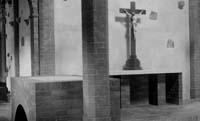
roughly finished off. Candles were burning on a candlestick. Beside this and the altar,
with its crucifix and its red and gold hangings, the tiny cottage was quite empty.
Above the altar was a niche, into which the figure of our Lady, an exact copy of the
original, taken from a seal of the Priory, was to be placed. Then I made my way back
to Walsingham church, which I found to be as crowded with people as before. An
oration was made by the Rev Alban Baverstock, and this was followed by the service
of Benediction. Then the great procession was formed.
As I walked with the other pilgrims along the streets of Walsingham village, I was
struck by the thought that here was a memorable meeting of past and present.
Nearly a thousand years ago, the first shrine was set up at Walsingham. Now, in twentieth-century
England, English people from all over the country had come for the renewing of the sanctuary. The
procession – and how like it must have been to the processions of old days, and yet how different! –
grew in size as villagers, who had left their work, and late comers joined it outside the church. The
cross led the way, then followed Walsingham children, in white, and
members of guilds of our Lady, in their blue and white veils. The figure of
the Virgin and Child was borne by four deacons of honour, and surrounded
by five guardians, Rev A H Baverstock, Rev H J Fynes-Clinton, Rev E H
Lury, Rev H Whitby, and Sir William Milner.
Behind the shrine, two by two, in open order, came the long line of eighty
priests, each with a lighted candle. Following upon them was the Abbot of
Nashdom and Bishop O'Rorke. Now the procession exceeded the whole
length of the village street; and still behind the Bishop were great numbers of the laity, some of whom
had scarcely left the church. Everyone carried a lighted candle.
The quiet of the ancient village seemed to receive the pilgrims, and to
offer to them the calm that dwells upon it – gained, perhaps, through
centuries of strife and turmoil. The candles burned with a steady flame,
for there was not a breath of air stirring. I wish we could have marched
in silence on this solemn occasion, feeling that the time was more fit for
prayer than singing. But, as it turned out, silence would have been
impossible, for, as the procession passed the Common Place, the
pilgrims were greeted with the “No Popery” cries of the Wycliffe
preachers. But even so, I thought that the hymns which the pilgrims were singing were unworthy of
the solemnity of the pilgrimage. Such crude rhymes and trivial tunes are
inappropriate to our Lady’s dignity, and inadequate for the expressions of praise to
Almighty God for her.
When the chapel was reached, the shrine was placed outside the main door, and
the courtyard was filled with all from the procession who could find a place there.
The rest of the people ranged themselves outside in the street, where had come
the Wycliffe preachers, still vociferous. The Magnificat was sung, and the shrine
was taken into the new chapel and placed in the niche prepared for it. Then priests
and people together sang the Te Deum. When my turn came to enter the chapel with other members
of the procession, the impression of calm and austerity, which the village had first given, was again
renewed. In the outer chapel, the altar of the Annunciation stood bare but for a fair linen cloth and a
wooden crucifix. The “house” within was a blaze of light, and the figure of our Lady, with the Child in
her arms, looked down from above the altar. But as I left the chapel on the further
side, I found myself upon the Via Dolorosa, and walking along it, past the pent-
house Stations of the Cross, I found that it led up to a
hillock, on which stood three great, wooden crosses.
Still further, at the end of the Way, I found that there
was built a model of the sepulchre in which the
Saviour was laid. Walsingham was holding its day of
solemn rejoicing. But it called its pilgrims, even as
they left the place of the shrine, to pause and to
remember the world’s rejection and crucifixion of the Divine Son of
Mary.
The last sight of Walsingham that the visitors had, before their return to London, was from the
platform of the station. The train had not yet come in, and crowds were looking back to the village and
down over the ruins of the old Franciscan Friary. The new chapel was hidden by the houses and trees;
but the bells, set up in their temporary wooden scaffolding at the side of the chapel, could be heard
pealing down the Stiffkey Valley, breaking now and again into the rhythm of a hymn tune, and
reminding the departed traveller, though he could not see it, that the new shrine at Walsingham had
been set up.
from East Anglian Daily Times 16 October 1931
A NEW SHRINE AT WALSINGHAM
REPLICA OF ELEVENTH CENTURY LADY CHAPEL
IMPOSING CEREMONIAL AT OPENING
A THOUSAND ANGLO-CATHOLICS IN PROCESSION
In the year 1537 the shrine of Our Lady of Walsingham, famous all over Europe,
was desecrated by the orders of Henry VIII. Yesterday, all but three hundred years
later, members of that church, which was established in the reign of his daughter
Elizabeth, opened once more a replica of that shrine and enthroned within it, with
all honour and devotion, another statue of the well. There are few more naturally
beautiful places in Norfolk than Walsingham and its surroundings, and the eleventh
century founders of the original shrine could not have chosen a more pleasant
setting for their renowned place of pilgrimage. A perfect autumn day, with the peaceful wooded vale of the
Stiffkey reflecting the autumn sunlight in tints of russet and yellow, favoured the celebrations which accompanied
the opening of the re-erected shrine.
Centuries must have elapsed since Walsingham, that Mecca of pilgrims, welcomed so many hundreds of people
from all parts of England. It was an impressive witness to the growth of the Anglo-Catholic movement in the
Church of England. Clergy in cassocks and birettas, and religious in their black, grey, or brown habits thronged
the streets of the little town, which were gay with flowers, evergreens, and bunting. From all over Norfolk and
the adjoining counties came contingents of lay folk and clergy, and a special train from London brought another
three hundred people.the procession in the High Street
The new shrine, which replaces one hitherto in the Parish Church, is modelled on the original
building destroyed in the reign of Henry VIII. Situated in Knight Street, the outer chapel of
brick and plaster with a red tiled roof, encloses an inner chapel, which is a replica of the Holy
House of Nazareth at Loreto. On entering the main doors of the outer building one has to
pass round to the opposite end to go into the inner sanctuary. Lit by
numerous silver lamps suspended from the ceiling, the Holy House has only a
tiny
window and bare rough walls, but the shrine itself blazes with gilt and colour.
Over the top is the inscription in Latin: "The Word was Made Flesh". While the
building work was in progress an ancient well, believed to be of the 14th
century, was discovered. The outer chapel encloses the well, which is now approached within by a
flight of steps. An interesting feature of the inner chapel is that the walls are studded with small
stones from many famous shrines, including St Peter's, Rome, St Paul's, Rome, Canterbury and
Glastonbury. The stones are mostly pieces of mouldings. The outside of the building has
incorporated in its structure stones from various famous monasteries.
A congregation which crowded the parish church to the doors attended the opening service, a
pontifical High Mass sung by Bishop O'Rorke, rector of Blakeney. Wearing the crimson cape and cassock of a
prelate, the Bishop passed in procession to the altar blessing the people, who knelt as he passed. "Faith of our
fathers" was sung while the Bishop was being ceremonially vested. Clad over all in a
magnificent chasuble heavily embroidered in gold and wearing a gold mitre, the celebrant
began the service, in which he was assisted by the Rev A Hope Patten, vicar of Walsingham, as
deacon, the Rev A W Leeds, curate, as sub-deacon, and the Rev Fr Ferrier (Shadwell),
assistant priest. The service throughout was one of elaborate ceremonial, and the sanctuary
was bright with candles, which hung in chandeliers from the roof. Among the clergy present,
who numbered close on a hundred, were the Lord Abbot of Nashdom, the Rev Lord Victor
Seymour, and Fathers Whitley [Whitby] (London), Wodehouse (Oxford) and Lury.
The preacher was the Rev Fr Underhill, late of St Thomas', Liverpool. He said that they were
going to do that which in God's good time would help to spread more and more the devotion of
Catholics to the Blessed Virgin Mary, and above all to the incarnation of her Divine Son. Men of
his age, said the preacher, looked back to the history of seventy or eighty years of the movement, and they saw
that God brought forth the old treasures of the Catholic faith, and was presenting them to the generations in
which they lived. Some of them used to think that they were lagging in the
presentation of the whole of the faith. But it seemed as he looked back that it was
in God's mercy that things should go a little bit slowly.
As he looked back and remembered the first glimmers of the Catholic faith, it
seemed that Mary was hardly known then. There were, however, certain great
things which their forefathers taught them about the Real Presence and the
Sacrament of Penance. As time swept on more and more of Catholic truth came
back into the minds of men and women in the English Church. Our Blessed Lady
began to take that rightful place in men's esteem which for all
those years until that vile Reformation Mary had received. So today they were going to do
something which would help towards making the worship of Our Lady of Walsingham no longer a
parish matter, but something that would be national. That day they were taking her to the new
sanctuary that was a copy of the Holy home where was nursed the little Babe Who was God
Almighty. From henceforth Mary had come back in to her own to show forth the incarnate life of
her Divine Son.
Again in the afternoon the Parish Church was crowded for Benediction. The Rev A Baverstock, of
Holy Family Homes, Duxhurst, gave an oration, in which he said that never was there such a
benefactress among mankind as the Virgin Mary. Throughout the ages every great victory for
Christianity was followed by a new devotion to Our Lady. Today another great danger to Christianity had arisen.
They saw a world bitterly hostile to the Christian faith, and to the very fundamental things, such as the Christian
home and the Christian institution of holy wedlock, which, no less than the Incarnation and the doctrines that
rested upon it, were bitterly attacked. "We are tempted", he added, "to lose heart when the Anglican trumpet
seems to give forth an uncertain sound or even to sound rather for the enemy than for the hosts of God. But we
must remember that we are told not to put out trust in princes - no, not even ecclesiastical princes - but in God."
The procession which issued from the Parish Church, with the seated statue of the Blessed Virgin upon its
throne, was an imposing one. Headed by cross-bearer and acolytes, and incorporating a big contingent of clergy
in cassocks and surplices, it must have been at least half a mile long. There was an imposing array of banners,
and all in the procession carried lighted candles. At the rear walked Bishop O'Rorke in cope and mitre and the
Abbot of Nashdom similarly vested. The pilgrims' hymn, with its refrain of "Ave, Ave, Ave, Maria" was sung to the
accompaniment of the Wells Town Band as the procession threaded the streets of the town. A modest estimate
put the total number of those in the procession at close on a thousand. Many hundreds of people had gathered
to watch. There was no disturbance of any sort, although a party of "Kensitite Wickliffe Preachers", who were
present with their van, shouted derogatory comments, addressed particularly to the clergy. The police were
present in force and regulated the traffic ably.
At the new shrine a halt was made, and after the statue had been incensed by the Bishop a solemn Magnificat
was sung. The statue was then enthroned in the interior shrine and the people filed past. The services concluded
with the Te Deum.
part of a report from 'Ave'
. . . . the culminating event must be considered the procession and setting up of the image in the holy
house. Picture then a perfect autumn day, with scarcely a breath of air stirring, the trees clothed in
glorious tints and in their setting of old Tudor houses and low red-roofed ancient cottages, a procession
with over a thousand people walking, each bearing his or her lighted taper; many women in blue veils,
little children in white casting their flowers; dark-habited nuns and monks; over a hundred priests in
cassock and cotta; the mitred Abbot of Pershore, and Bishop O'Rorke. Behind streamed the many
hundreds of other people, all singing the glories of Mary, and in the midst of this throng, high and lifted
up upon the shoulders of four clergy in dalmatics, and under a blue and gold canopy fixed to the feretory,
sat the venerated figure of Our Lady, crowned with the silver Oxford Crown, and robed in a mantle of
cloth of gold.
Around the feretory walked men carrying torches; in front the lay guardians of the shrine who were able
to be present; and behind five of the priest guardians, and immediately following them a group of
banners from various parishes, and pilgrim banners. The procession passed between streets hung with
flags and wreaths of flowers and evergreens, accompanied by singing and the chiming of the bells of the
ancient parish church.
When the head of the procession, which was over half a mile long, arrived at the Court before the
sanctuary, the bells of Our Lady's chimes rang out. The processionists formed up in semi circular rows on
either side of the Porch — first the women in veils, then the nuns, then the monks and the clergy. Finally
the Abbot and Bishop reached the entrance to the church, before which rested the image of Mary
surrounded by torches and her attendants. The prelate intoned the Magnificat and incensed the Blessed
Virgin, at the conclusion of which the feretory was again lifted, and to the strains of the Salve Regina,
passed into the Chapel and the Holy House.
Here it was enthroned in the niche prepared above the altar. The relic of the tomb of Our Lady was then
placed upon the altar, as well as the casket - containing the golden book, which had been carried in
procession by two girls veiled in white. Two deacons then came to the Bishop for a blessing. One
remained in the Holy House, while the other went to the entrance of the church, and in both places the
Gospel for the Feast of the Annunciation was sung simultaneously. The function concluded with a solemn
Te Deum sung by all within and around the Shrine and those standing in the road outside. It took three
quarters of an hour for the pilgrims and visitors to pass in quick succession through the Shrine without
pausing.
from an unidentified contemporary magazine, reprinted in Walsingham Review in 1991
Fine autumn weather, the aftermath of a wretched summer, tempted us to start from London a day
early for the dedication of the new shrine of Our Lady of Walsingham. So, on the morning of October
14th, we set out from London by car, and having successfully negotiated Camden Town, Seven Sisters
Road, Holloway and Finsbury Park, and passed through Epping Forest, glowing with autumn tints, we
presently turned aside to admire the glorious Essex church of Thaxted. Thence we made Cambridge
just in time for luncheon, and in the early afternoon approached Ely Cathedral rising majestically out
of the fens. Of course, we were obliged to halt there and devote some time to the beauty of its
architecture. A further good run brought us to Fakenham, and just as dusk was falling we found
ourselves entering Walsingham: a village of grey flint houses built round what remains of the ancient
Priory of Augustinian Canons. Our first objective was the Church, where we found a friendly nun
putting last touches to the decoration of our Lady of Walsingham's statue before it departed tomorrow
to its new home. The Lady Chapel looked to us desolate without the gracious figure of the Mother and
Child. But on our way from the Church to tea at the Hospice of our Lady Star of the Sea, we passed
the new shrine and at once saw that it would be in every way a worthy resting place. The shrine has
been built on a plot of ground belonging to the Hospice. It has in front a semicircular courtyard, paved
with cobblestones, and in spite of being in reality quite small, the holy house itself looked tall and
imposing against the evening sky. The hour was too late for an inspection that night, so our visit to
the interior had to be postponed till next day. Later on, walking through the village, we were struck by
the decoration of the streets and houses. Across the principal street hung garlands of evergreens,
flags were everywhere in evidence, while even in the cottage windows villagers displayed gay
bouquets of autumn flowers. These decorations showed up well against the old grey stone of the
square, and the streets that lead to it. Presently a bright little moon added to the beauty of the scene,
and lighted us on our way to Blakeney, some eight miles distant, where we were to stay for the night.
Next morning, at Walsingham, Masses were said in the Parish Church by several priests staying at the
Vicarage as the guests of Father Hope Patten. Autumn mist hung over the country in the early hours,
but by eleven o'clock the sun had broken through. The rest of the day was fine, a most important
matter considering the length of the route to be taken by the procession from the Church to the
Shrine. Half-an-hour before Pontifical High Mass was timed to begin, the side aisles of the Church
were quite full. The choir and several front rows on each side of the nave were reserved for clergy,
who, including the contingent from London, numbered about seventy. The rest of the Nave had been
roped off for those arriving at half-past eleven by the special train from London: but even this larger
number of seats proved inadequate, for the whole space round the splendid old font and back as far
as the west door was soon crowded as well. With some difficulty when all were assembled, a way was
found for the procession of the officiating Bishop and clergy up the centre of the nave to the
Sanctuary. Pontifical High Mass followed, with Bishop O'Rorke, formerly of Accra, pontificating, Father
Hope Patten and his assistant priest acting as deacon and sub-deacon. After the Creed, an interesting
and moving sermon was preached by Father Underhill, who spoke of the many changes he had seen
during the long years when he made St Thomas', Liverpool, a stronghold of the Catholic faith. When
High Mass was over we found ourselves part of a great throng in the churchyard. Here a jarring note
was struck by some adherents of Mr Kensit (one of them a truculent looking man of colour), who had
established themselves and their van outside the churchyard gate. However their odd behaviour
attracted little or no attention except from a few small boys of the village. We were all intent on
making a preliminary visit to the shrine before luncheon, and its beauty proved wonderfully arresting.
The shrine itself is quite small; the rough walls are beautifully adorned with stones and carvings
collected from churches and religious houses of great antiquity in England and throughout Europe.
On entering and passing through a short passage, one arrives first of all at the well, with its staircase
descending to the water, for the use of pilgrims. Passing round we had a view of the altar, before
which many candles were already burning, though the niche behind was as yet empty. In spite of
being small the Chapel looked most imposing with its decorations of gold and silver, and crimson
hangings. Certainly Sir William Milner and his partner, Mr Craze, who designed and carried out the
work, have made it a wonderful success. And later on, when the seated figure of our Lady and the
Holy Child had been placed on its appointed recess for the veneration of the faithful, one experienced
the same wonderful feeling of 'atmosphere' as for instance in the grotto at Lourdes: or in the Chapel
of Paray le Monial where Margaret Mary Alacocq was vouchsafed her visions of the Sacred Heart.
The luncheon interval, in the garden of the Hospice, passed quickly, and soon after two o'clock we
were all on the move again for the Church. At half-past two the service began with a panegyric
pronounced by Father Baverstock: his statement that to-day's happening at Walsingham was one of
the most notable events of the Catholic movement in the Church of England was in full agreement
with what many of us were feeling at the moment. After the panegyric came Solemn Benediction, and
then the procession to the Shrine began to be formed. The statue of our Lady of Walsingham was
borne down the Nave on the shoulders of four deacons of honour, and there were priests walking
beside the image, including Father Fynes-Clinton, Father Whitby and Father Baverstock. Sir William
Milner, as the architect of the Shrine, led the way, in front of the crucifix and torch bearers, after
which followed two long lines of priests properly vested and each carrying a lighted candle. Then came
the Abbot of Nashdom and Bishop O'Rorke, vested in cope and mitre. The large body of laity followed,
everyone bearing a lighted taper, and this part of the procession gained much from the excellent staff
work of the stewards, who kept the two lines of pilgrims wide apart, so that there was no straggling or
confusion. One could not help wishing, though, that the devotion of the faithful did not find vocal
expression while the procession went through the village. The singing, as always in the open air was
very thin, and those in front seemed very often to be singing quite a different hymn to those behind.
On arrival at the Shrine, however, it became necessary to sing `Faith of our Fathers' as loudly as
possible, for the Wycliffe preachers had taken up a strategic position, and did their best — happily
without much success — to be vociferous. Soon hymn singing gave place to the Magnificat, then the
collect for the Feast of the Annunciation was recited, and finally all joined in the Te Deum as a final
and very impressive act of thanksgiving. This being concluded, first the clergy and then the laity
passed through the chapel in single file, everyone kneeling to make a short prayer before the altar and
the statue of the Walsingham Madonna, now established in her permanent resting place.
When this almost endless stream of pilgrims had passed through the shrine, all adjourned to the
Hospice Garden for tea and soon it became necessary for those returning by train to make for the
station. Parties by motor-coach and char-a-banc also left as darkness began to fall. It was, indeed the
end of a perfect day; and we, who had still leisure before going back to Blakeney, lingered awhile in
the garden and paid a visit, with the Abbot of Nashdom as our cicerone, to the house close by lately
acquired by the Nashdom Benedictines. And last of all we made a farewell visit to the Shrine, by that
time quite empty except for a young religious who was rearranging the many candles placed on
prickets by the faithful. A last prayer before the altar, a last look at the face of Our Lady of
Walsingham up above, and we too took to the road. The feeling was strong upon us that we had seen
and experienced wonderful things that day. No one who had the privilege of being there could surely
fail to remember with joy and gratitude the great day of the Feast of St Teresa of Jesus 1931, on
which had taken place with such devotion the translation of the statue of our Lady of Walsingham.
top of page