St Augustine’s Chapel
an unusual and largely forgotten history
There have been three St Augustine’s Chapels in succession on the same
spot in the Shrine Church since 1938, but it was never one of the ‘Fifteen’
Chapels of Fr Patten’s vision, represent the Mysteries of the Rosary, which could be
followed through the Church in sequence. In 1934 Fr Patten had formed his quasi-
monastic Community of St Augustine, and in the new Church he created another
chapel, dedicated to St Augustine of Hippo, situated apart from the rest. (The
Community was dissolved in 1958 after Fr Patten’s death.)
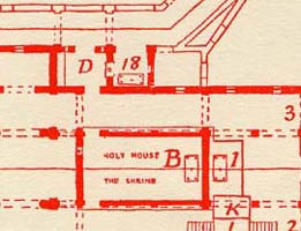
(1) It was originally an outside chapel, as can be
seen from the ground plan in the 5th edltion (1939) of
Fr Patten’s Little Guide [left], where it is marked ‘18’,
and the position of its altar can be seen. The letter ‘B’,
below that, denotes the Holy House, and ‘1’ to the
right, denotes the Annunciation Altar. ‘D’ denotes St
Augustine’s Porch, an exit from the building.
Note that the plan in this booklet does not reflect
exactly the final result, as here and elsewhere in it.
Under the Shrine at this point is the Crypt, where
visitors could view medieval remains discovered
during the 1931 and 1938 building works. Pilgrims
remember this experience as being more crawling
than viewing*.
(2) It became an inside chapel in 1951.
from Our Lady’s Mirror Winter Number 1951
[Note that to Fr Patten the 'Winter' Number was the first issue of any OLM year, not the last]
The donation of a friend who wishes the work to be done in memory of her brother [Fr Charles
Boyle Woolley] has enabled us to put in order the Chapel of S Augustine. We propose keeping the
relics there behind a grill. Pilgrims will remember that derelict-looking chapel outside S
Augustine’s porch, with its unused and unfurnished altar, all waiting for an opportunity such as
this. It is a great joy to be able to get this in order at last: materials for frontals, hangings, a mat
6ft. long by 3ft. 6in. wide, in dark colours, a chalice, a missal and stand, vestments and other
suitable furnishings would be gratefully received.
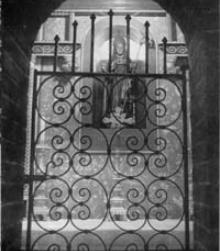
[left] Looking through the gate after
the 1951 refurbishment: the chapel
was brought 'inside' the Shrine
Church by making its entrance onto
the South aisle and blocking up the
outer wall.
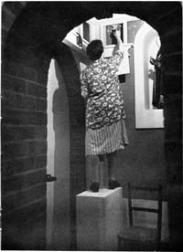
[right] This chapel, like most of the
others, was highly decorated by Enid
Chadwick, seen here at work on it in
1951.
from Our Lady’s Mirror Summer
Number 1951
We had hoped to have been able to use S. Augustine’s Chapel for [Easter], but alas, the work of
decorating and furnishing has all been held up – the former for want of gold leaf, although two
friends of the Shrine generously helped by giving some books [of gold leaf] and so enabled us to
make a start.
We know from Fr Patten’s notes that the chapel contained a wooden baldacchino on four
columns, a stone altar, the image of St Augustine (a copy of one over the the entrance to
the chapel of the Hospital of St John, Bruges), the statue of St John Nepomuk (now moved
elsewhere in the Church), an iron gate and the plaque shown below.
The 1951 Chapel was used by the Community of St Augustine for their daily offices.
It was also used as the Altar of Repose in Holy Week.
(3) All this changed when the Jubilee Cloister was built in 1972 and the chapel was
reoriented and furnished in the simple manner it is now. The brickwork of the two east archways
illustrates these alterations.
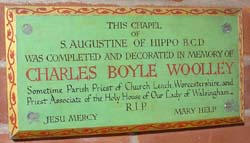
A plaque still there [right] records that the refurbishment of this chapel was done in memory of
Charles Boyle Woolley, Rector of Church Lench 1914-44, but
fails to explain that this refers to the previous (1951) chapel.
Fr Woolley died in 1948.
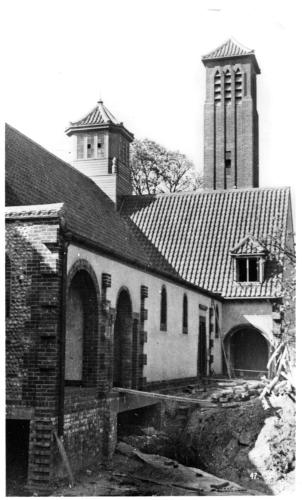
*This [left] is the south wall of the new Shrine
Church, in 1938, showing work in progress, and
the entrance to the Crypt underneath.
At ground level, from left to right: St Augustine’s
[outside] chapel, **St Augustine’s Porch (an exit
from the Shrine Church and later extended
outwards), the two windows of St Anne’s chapel
(at that time spelled Ann), another exit from the
Shrine Church (from SS Thomas and Philip
Chapel), another window, and then at right
angles the main exit door.
This is where the Jubilee (South) Cloister was
built in 1972.
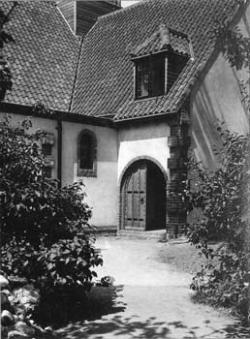
[right] ready for the opening of the
church in 1938, looking towards the
main door, as above.
**St Augustine’s Porch
This photograph needs interpretation, accompanied by the two postcards below:
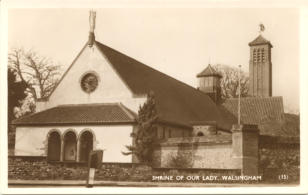
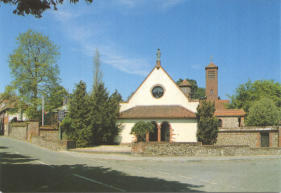
These show (left) brickwork apparently protruding from the wall by St Augustine’s Chapel,
and (right, date between 1966 and 1972) what looks like an extension of that wall,
perhaps a larger porch.
In the photograph the edge of this brickwork can be seen on the extreme left, and a sliver
of the window on the very left edge of that. Even longtime pilgrims pre1972 seem not to
remember much about what that side of the church looked like in those days. If anyone
does, please contact the Shrine Archivist.